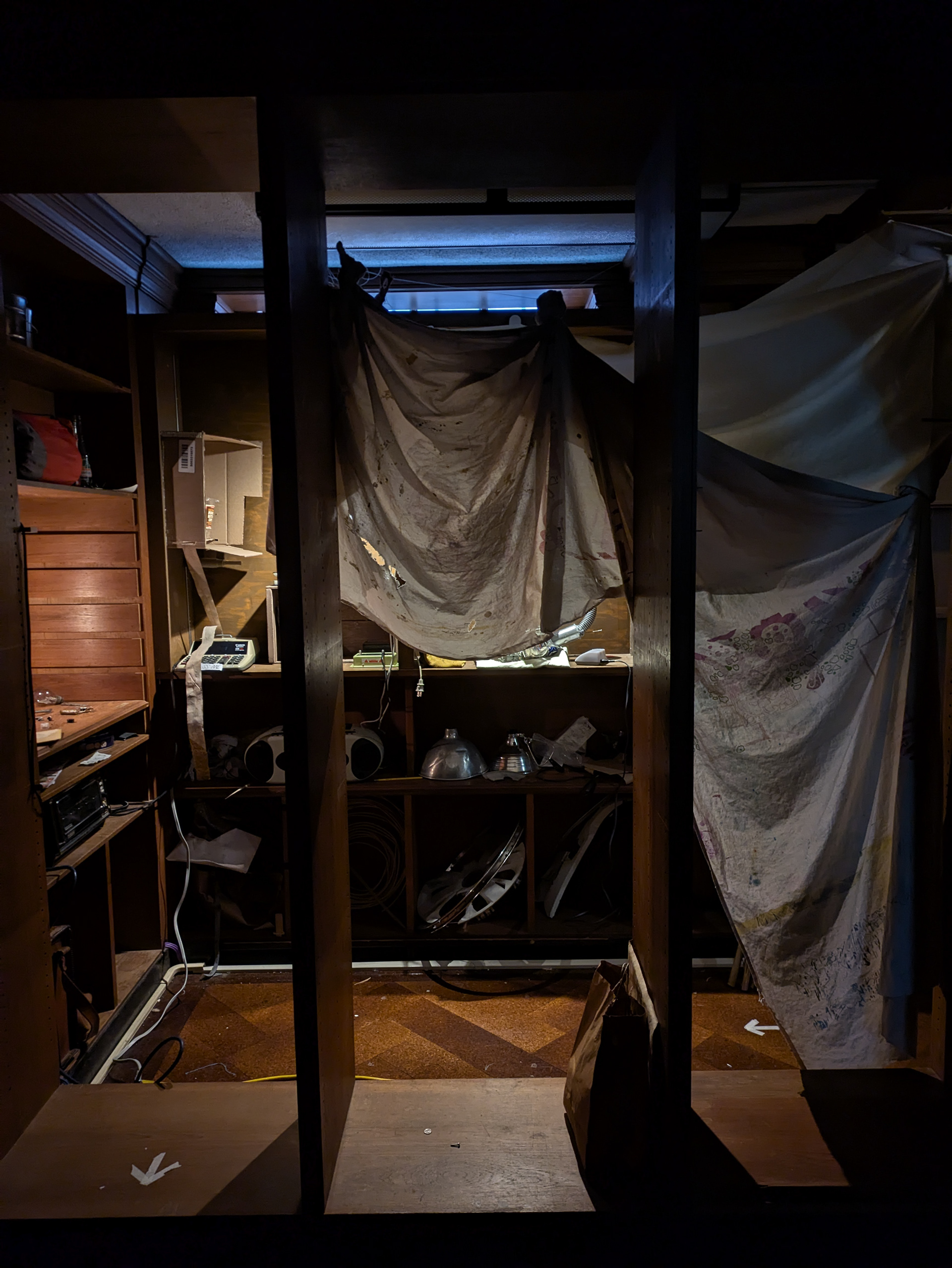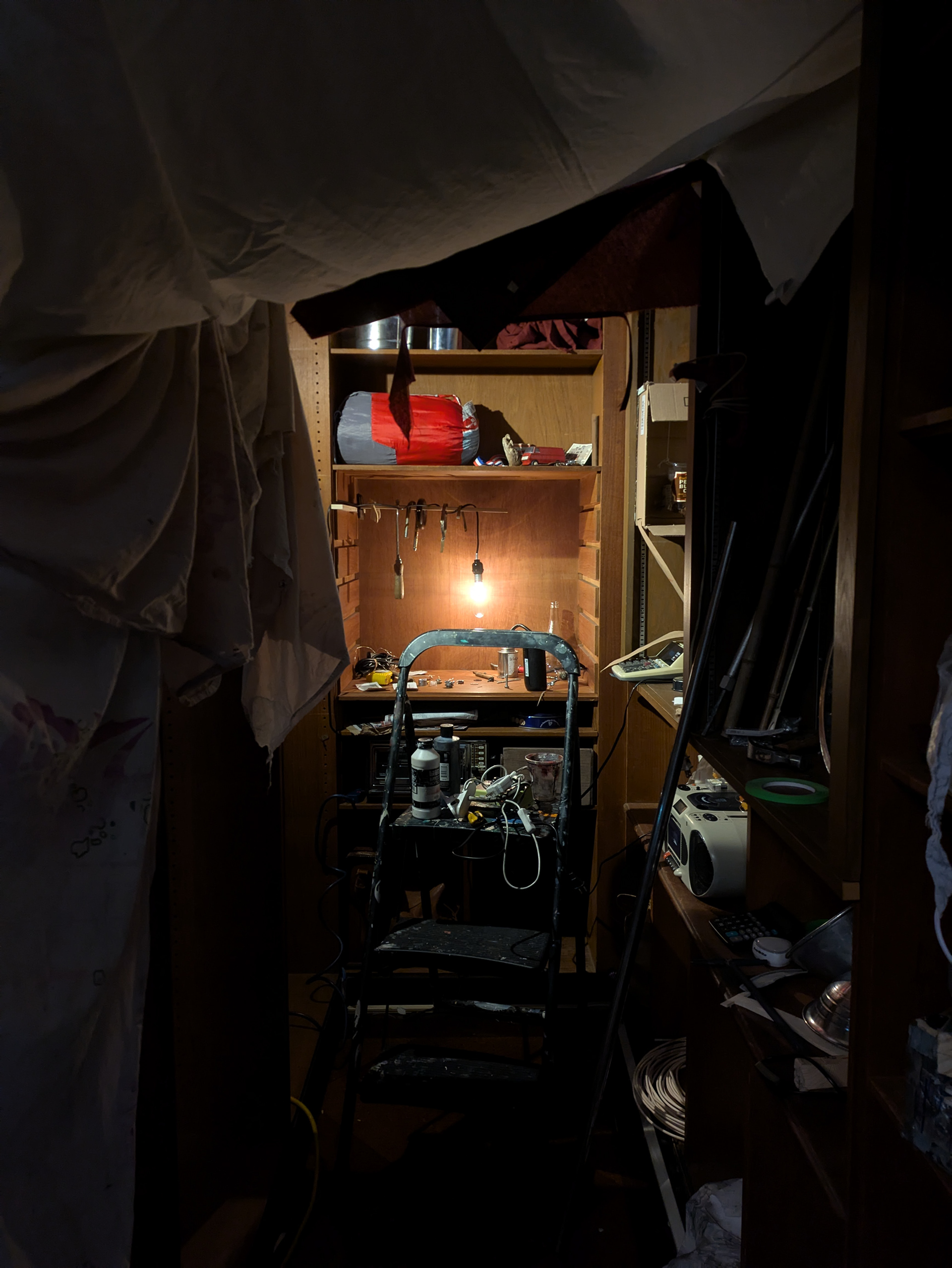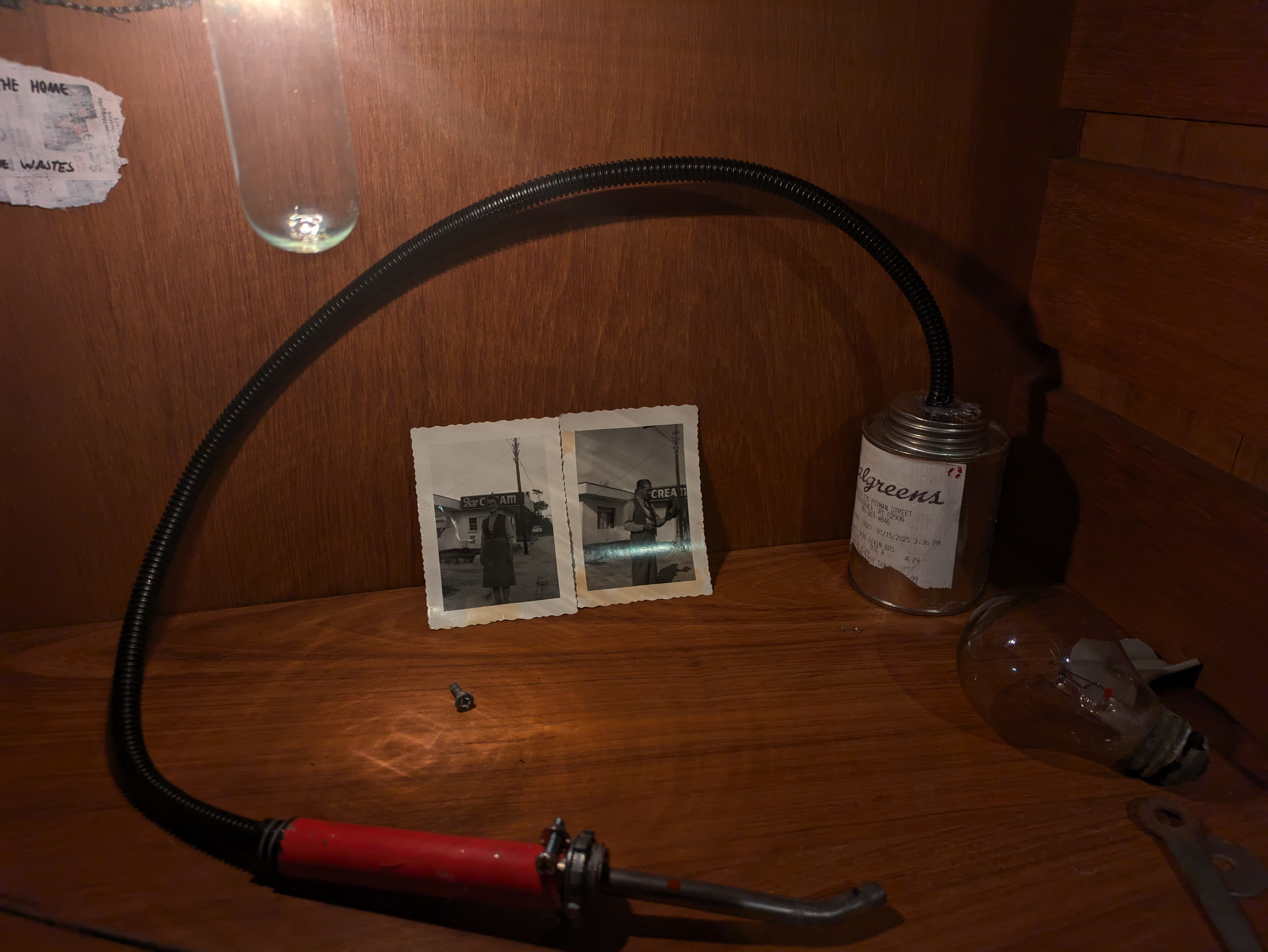
Closeup on the workbench, photos of the Inventor and family pre-collapse
My installation on the Inventor in the fictional Carrefour Center, was the climax of my semester-long exploration: It was a celebration of craft, found object, and audio. This, and an investigation on how we interact with history: the way we separate ourselves from the past in museum settings, and how that divide may be bridged.
I explored the Inventor and his apocalyptic world in a previous project on found material (featured at left). Find below the original artist's statement:
"The world is a wasteland, decimated by some cataclysmic event, and in order to survive, one must make use of the wreckage. Our survivor is an inventor, who does just that, taking what he finds to create machines that help him not only live, but thrive. He must be quick about his trips to the surface, the wars may be over with no one left to wage them–but in place of the airships, flash floods and dust storms still pelt the earth all the same. One of his most important creations is a wearable that acts as an early weather warning system and detector for “usables” so he can make the most of his trips. The device has an old bicycle gear, that when cranked, produces readings on the surrounding area through an old light switch cover. Towards the elbow, is a red light bulb that swivels on a caster, illuminating the surrounding area, below this are elements of the device's power supply, batteries to power the little machine, and plugs for his auxiliary tools, should he need them."
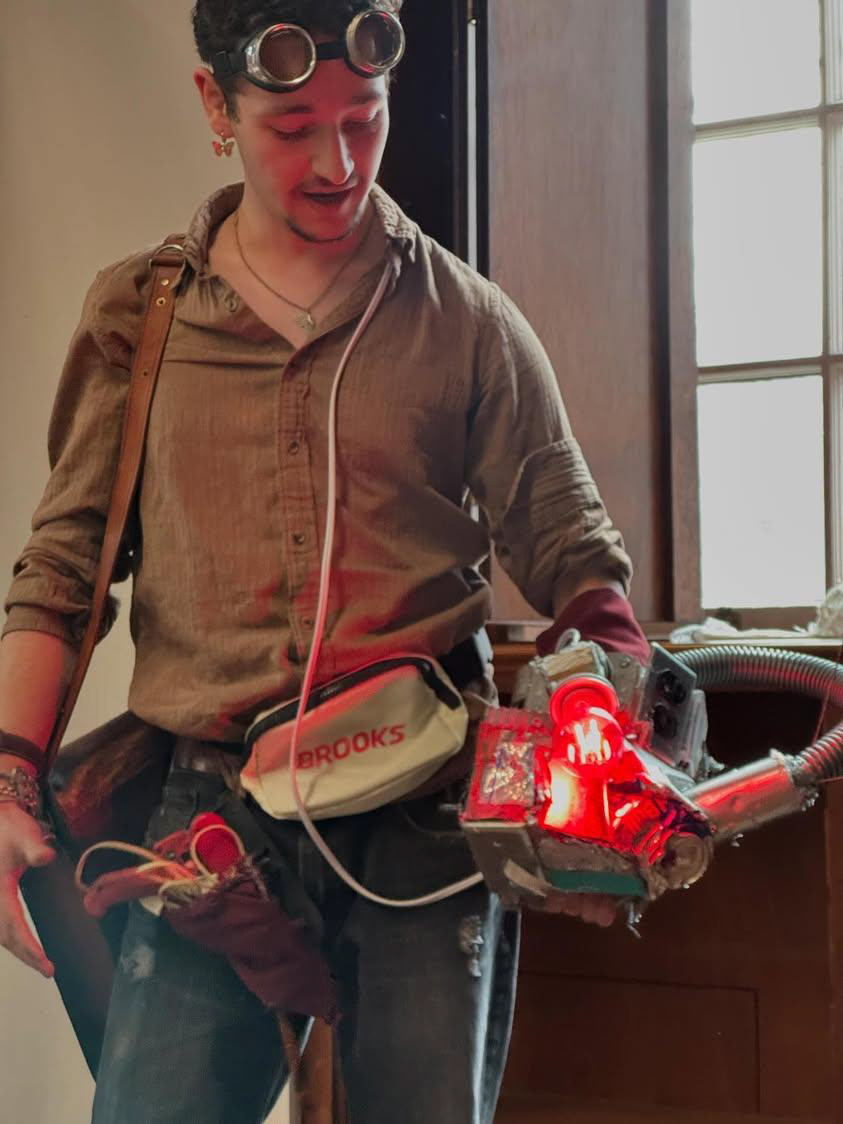
The first project taking place in this world, a device designed to find usable rubbish.
I wanted to probe deeper into this world, and so for my final, I created a house museum's period room of the Inventors home, set a few decades after his adventures.
I wanted to highlight his man as a local legend. A hero to this town struggling to rebuild after the apocalypse, who inspires an entire way of life. To cherish the found object, see all the possibilities in rubble for new seeds to sprout.
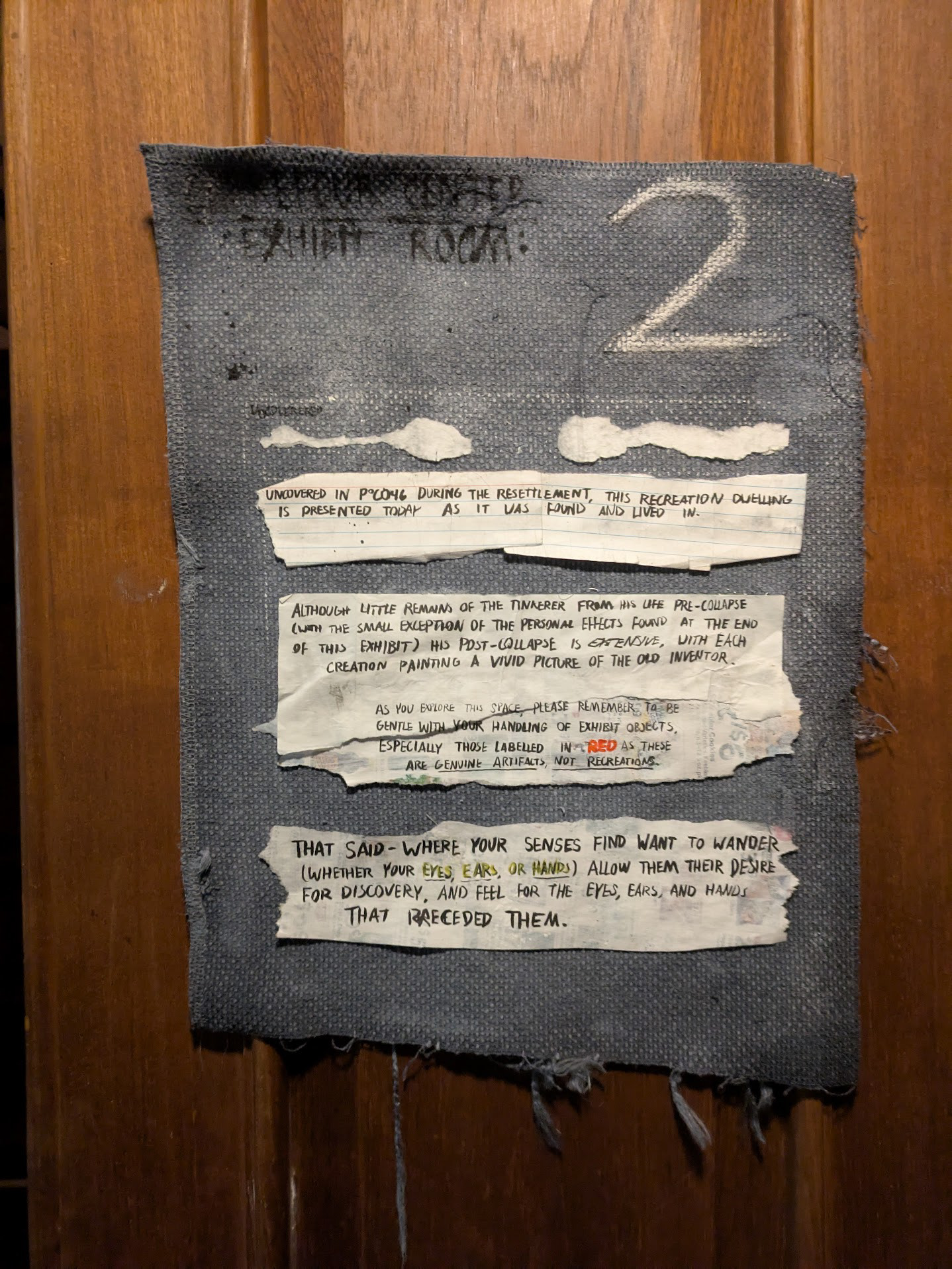
Carrefour Center - Exhibit room 2
Uncovered in PᵒC046 during the resettlement, this recreation dwelling is presented today as it was found and lived in.
Although little remains of the Tinkerer from his life Pre-Collapse (with the small exception of the personal effects found at the end of this exhibit) his Post-Collapse record is extensive, with each creation painting a vivid picture of the old inventor.
As you explore this space, please remember to be gentle with your handling of exhibit objects, especially those labelled in red as these are genuine artifacts, not recreations.
As you explore this space, please remember to be gentle with your handling of exhibit objects, especially those labelled in red as these are genuine artifacts, not recreations.
That said - where your senses find a want to wander (whether your eyes, ears, or hands) allow them their desire for discovery, and feel for the eyes, ears, and hands that preceded them.
More than Survive
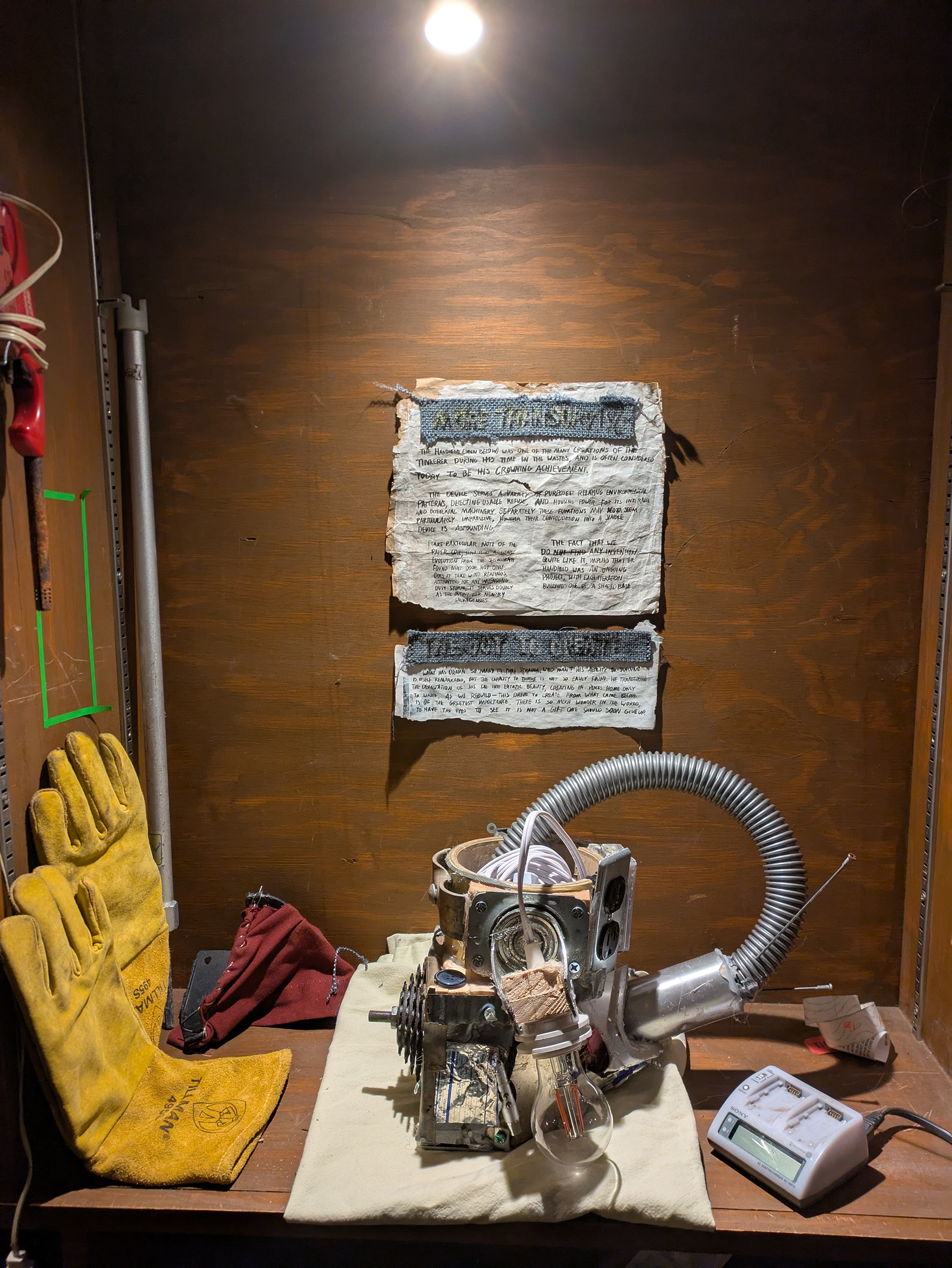
The Handheld (seen below) was one of the many creations of the Tinkerer during his time in the wastes, and is often considered today to be his crowning achievement.
The device serves a variety of purposes: relaying environmental patterns, detecting usable refuse, and housing power for its internal and external machinery. Separately these functions may not seem particularly impressive, however their consolidation into a single device is astounding.
Take particular note of the paper coil, how it is a clear evolution from the seismograph found next door. Not only does it take wind readings, accounting for any impending dust storm, it serves doubly as the output for nearby salvageable.
The fact that we do not find any invention quite like it, implies that the Handheld was an ongoing project, with each iteration building off of a shared base.
The Joy to Create
What has drawn so many to this strange, wild man? His ability to survive is itself remarkable, but the capacity to thrive is not so easily found. He transformed the devastation of his life into ecstatic beauty, creating in places home only to waste. As we rebuild–this drive to create from what came before is of the greatest importance. There is so much wonder in the world, to have the eyes to see it is not a gift one should soon give up."
“We comfort ourselves by reliving memories of protection. Something closed must retain our memories, while leaving them their original value as images. Memories of the outside world will never have the same tonality as those of home and, by recalling these memories, we add to our store of dreams; we are never real historians, but always near poets, and our emotion is perhaps nothing but an expression of a poetry that was lost.”
― Gaston Bachelard, The Poetics of Space